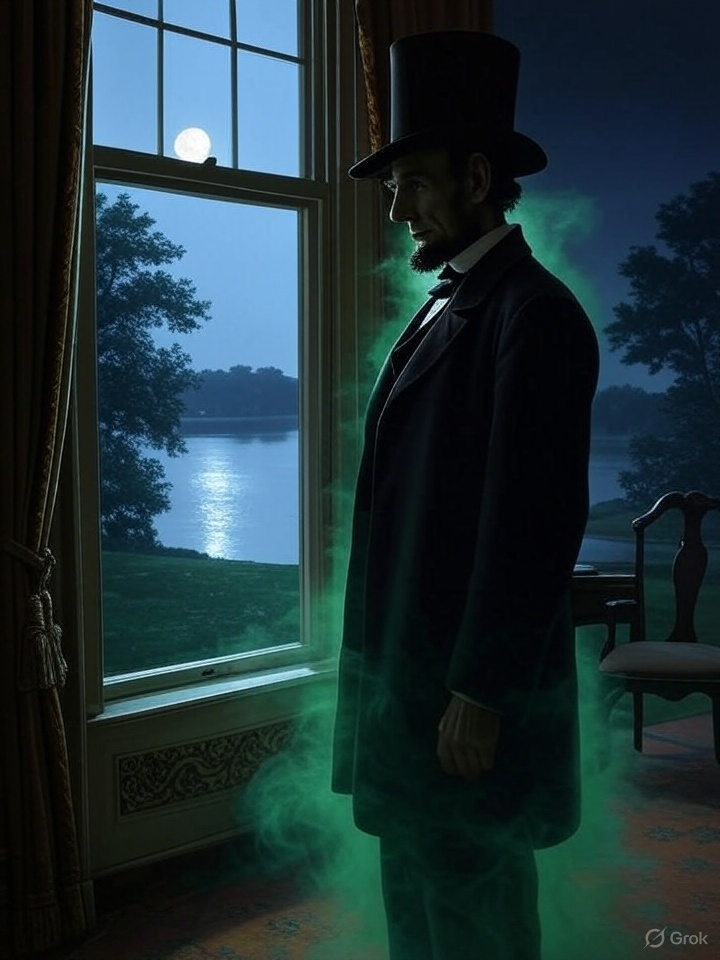
The legend of Abraham Lincoln’s ghost, often referred to as the “White House Ghost,” is one of the most famous paranormal stories associated with the White House. Since his assassination in 1865, numerous reports have claimed that Lincoln’s spirit haunts the Executive Mansion, as well as other locations tied to his life, such as his former residences in Springfield, Illinois, and Ford’s Theatre in Washington, D.C. Below is an overview of the key claims, sightings, and cultural context surrounding this phenomenon, drawing on historical accounts and skepticism to provide a balanced perspective.
Key Sightings and Claims
- Early Reports and Jerry Smith: The legend may have originated with Jeremiah “Jerry” Smith, a White House footman, butler, and doorman who worked there from the late 1860s until his death in 1904. Known as the “Knight of the Feather Duster,” Smith was a colorful storyteller who claimed to have seen the ghosts of Lincoln, Ulysses S. Grant, and William McKinley, describing them as producing a “buzzing sound” when trying to speak. His stories, shared with reporters, likely helped popularize the idea of Lincoln’s ghost in the late 19th century.
- Grace Coolidge (1920s): First Lady Grace Coolidge was the first prominent figure to report seeing Lincoln’s ghost. She claimed to have observed him standing at a window in the Yellow Oval Room, gazing toward the Potomac River, possibly reflecting on the Civil War battlefields.
- Queen Wilhelmina (1942): One of the most famous sightings occurred during a visit by Queen Wilhelmina of the Netherlands. She reportedly heard a knock at her bedroom door in the Lincoln Bedroom, opened it, and saw Lincoln in a top hat and frock coat. She fainted and awoke to find the apparition gone.
- Winston Churchill (1940s): A popular but debated story involves British Prime Minister Winston Churchill during a World War II visit. After emerging from a bath, naked except for a cigar, Churchill allegedly saw Lincoln leaning against a fireplace mantle in the Lincoln Bedroom. He quipped, “Good evening, Mr. President. You seem to have me at a disadvantage,” and Lincoln’s ghost smiled before vanishing. However, some sources, including Churchill’s daughter Lady Soames, suggest he was not easily spooked and question the story’s authenticity, noting the Lincoln Bedroom was not called that until 1929 and was used as a study during Lincoln’s time.
- Other Notable Claims:
- Eleanor Roosevelt, who used the Lincoln Bedroom as a study, never saw the ghost but felt Lincoln’s presence while working late at night.
- Lady Bird Johnson, press secretary Liz Carpenter, and President Dwight Eisenhower’s press secretary James Hagerty reported sensing Lincoln’s presence.
- President Harry S. Truman and his daughter Margaret heard unexplained footsteps or rapping at the Lincoln Bedroom door, with Truman believing it was Lincoln.
- Ronald and Nancy Reagan’s dog, Rex, reportedly barked at the Lincoln Bedroom door and refused to enter, with staff attributing odd noises or missing items to Lincoln’s ghost.
- In the early 1980s, White House operations foreman Tony Savoy claimed to see Lincoln sitting in a chair at the top of a staircase.
- Willie Lincoln, Abraham’s son who died of typhoid in the White House in 1862, is also said to haunt the premises, with sightings reported during the Grant administration and by Lynda Bird Johnson Robb in the 1960s.
Other Locations
Beyond the White House, Lincoln’s ghost has been reported elsewhere:
- Ford’s Theatre: Visitors have described hearing a gunshot, screams, or seeing Lincoln in his box during performances, evoking the night of his assassination.
- Peterson House: The room where Lincoln died across from Ford’s Theatre is said to evoke heavy, sad feelings, with some reporting his spectral presence.
- Springfield, Illinois: Lincoln’s former law office and home are rumored to be haunted by his spirit.
- Phantom Train: Stories persist of a ghostly funeral train following the route of Lincoln’s 1865 funeral procession from Washington, D.C., to Springfield in April.
- Other D.C. Sites: Sightings have been reported at the Capitol, Pennsylvania Avenue, and even the Lincoln Memorial, despite it being built after his death.
Cultural and Historical Context
- Spiritualism in the 19th Century: The Civil War’s massive death toll (over 600,000) fueled the Spiritualist movement, which posited that the living could communicate with the dead. Mary Todd Lincoln, devastated by the deaths of her son Willie and her husband, participated in séances in the White House’s Red Room and elsewhere, seeking to contact them. Her 1872 photograph with William H. Mumler, showing a faint figure resembling Lincoln behind her, became a sensation but was later debunked as a double-exposure hoax.
- Mumler’s Spirit Photography: William Mumler’s 1872 photograph of Mary Todd Lincoln with Lincoln’s alleged ghost capitalized on Spiritualist beliefs. Despite investigations, including by photographer J.W. Black, the exact method (likely double exposure) was never proven, though Mumler was acquitted of fraud in 1869. The image remains a cultural artifact of grief and belief in the supernatural.
- Lincoln’s Legacy: Lincoln’s assassination, personal tragedies, and role in preserving the Union during the Civil War made him a larger-than-life figure, ripe for ghost stories. His melancholy demeanor and reported premonitions of his death (e.g., a dream of his body lying in state) added to the mystique.
Skeptical Perspective
- Psychological and Environmental Factors: The White House’s historical weight, combined with its creaky old structure, likely contributes to perceptions of hauntings. Stress, grief, or suggestion may explain many experiences, especially for figures like Mary Todd Lincoln, who suffered significant trauma.
- Lack of Evidence: No definitive proof—photographic, audio, or otherwise—supports the sightings. The Mumler photograph, while compelling to Spiritualists, is widely regarded as fraudulent. Anecdotal accounts, even from credible figures like Churchill or Coolidge, lack corroboration and could reflect cultural fascination or embellishment.
- Storytelling and Exaggeration: Jerry Smith’s tales and media amplification likely fueled the legend. Churchill’s story, for instance, may have been a humorous anecdote or invented to enhance his colorful persona, as no direct record from him confirms it.
- Comparison to Doris Bither Case: Unlike the Doris Bither case, which involved a single family and a short investigation with limited documentation, Lincoln’s ghost stories span decades and involve prominent figures, giving them greater cultural staying power. However, both cases suffer from a lack of verifiable evidence and rely heavily on witness testimony, with possible psychological or environmental explanations. The Bither case’s focus on poltergeist activity tied to personal trauma contrasts with Lincoln’s ghost, which is more about a historical figure’s lingering presence tied to national trauma.
Cultural Impact
- Media and Fiction: Lincoln’s ghost has appeared in popular culture, including the novel Lincoln in the Bardo by George Saunders, which imagines Willie Lincoln’s spirit in a liminal afterlife, and episodes of The Venture Brothers and The Ghost and Molly McGee, where Lincoln’s ghost is a character.
- Enduring Fascination: The persistence of Lincoln’s ghost stories reflects his status as an American icon and the nation’s unresolved grief over the Civil War and his assassination. The White House, as a symbol of power, amplifies these tales.
Critical Perspective
The Abraham Lincoln ghost legend is a blend of historical reverence, Spiritualist fervor, and human psychology. While the sheer number of reported sightings from credible figures lends intrigue, the absence of concrete evidence and the era’s cultural context suggest these may be products of imagination, suggestion, or storytelling. Compared to the Doris Bither case, Lincoln’s ghost is less about personal trauma and more about collective memory, but both highlight the human tendency to seek supernatural explanations for the inexplicable. Whether Lincoln’s spirit truly lingers or not, the stories underscore his enduring impact on American consciousness.
About the Author