Robert the Doll is a real, century-old object with a long and layered history that blends documented facts about its owner with decades of folklore, rumours, and reported paranormal claims. Here is the full story as it is commonly told and recorded.
Origins and Early Life (1904 onward)
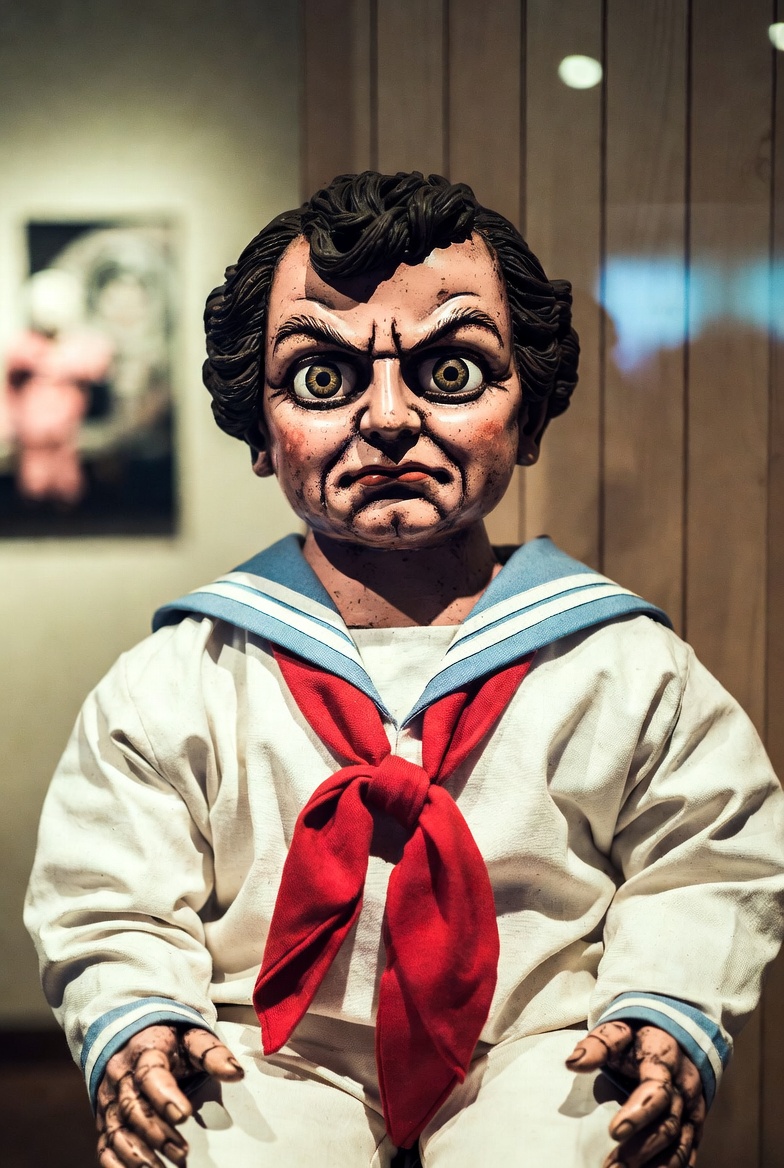
In 1904, a young boy named Robert Eugene Otto (born in 1900 and known as “Gene” to family and friends) received a unique, handmade doll as a gift. The doll stands about 40 inches tall, is stuffed with wood wool (excelsior), and wears a sailor suit that may have been modelled after one of Gene’s own childhood outfits. Its painted face has a somewhat jester-like or clownish appearance. The most widely accepted historical account is that the doll was manufactured by the German company Steiff (famous for teddy bears) and was likely originally created as part of a window display set rather than a standard children’s toy. It was reportedly purchased by Gene’s grandfather during a trip to Germany and given to the four-year-old boy as a birthday present.
A popular legend offers a darker version of the gift: some stories claim the doll was given to Gene by a young servant girl of Bahamian descent who worked for the wealthy Otto family in Key West, Florida. According to this tale, the servant was mistreated by the family and placed a voodoo curse on the doll as revenge before giving it to the child. (This voodoo element is folklore and has never been historically verified.)Gene immediately became deeply attached to the doll. He gave it his own first name—Robert—and from then on referred to himself as “Gene” to avoid confusion. The two were nearly inseparable. Gene treated Robert like a living companion: he talked to the doll, carried it everywhere, and even set a place for it at the family dinner table .
The Blame Game and Growing Strangeness
As Gene grew up in the prominent Otto family home at 534 Eaton Street in Key West, a peculiar habit developed. Whenever the boy got into trouble or something went wrong—broken objects, mischief, or minor accidents—he would point to the doll and insist, “Robert did it.” What began as a child’s way of shifting blame reportedly evolved into something more unsettling. Family members and servants claimed to hear giggling coming from empty rooms, see the doll’s expression change, or find Robert in different positions or locations than where he had been left. Gene’s parents and others in the household allegedly witnessed odd events around the doll, though accounts from the time are anecdotal. The Otto family was known for its eccentricity, and Gene himself grew into an artistic, unconventional man.
Adulthood and Continued Companionship
Gene studied art in New York, Chicago, and Paris. During these years, Robert the Doll remained behind, stored in the family home on Eaton Street. In 1930, Gene returned to Key West with his new wife, Anne. The couple moved into the Eaton Street house (later known as The Artist House), and Robert came with them. Gene continued his career as a painter, photographer, and author, becoming a well-known figure in Key West’s artistic community. He even helped design a gallery space at what is now the East Martello Museum. According to legend, Robert the Doll stayed by Gene’s side throughout his adult life. Some stories say the doll was kept in a dedicated room or even had its own chair. Visitors and family reportedly felt uneasy around it, describing a sense that it was “watching” them. Gene’s wife Anne was said to dislike the doll intensely and eventually insisted it be moved to the attic or a separate space. Gene Otto died in 1974 at the age of 74. After his death, the doll passed to his wife Anne, who kept it for a time before it went to the next caretaker.
The Next Keeper and the Move to the Museum
The doll eventually came into the possession of Myrtle Reuter, who acquired the Otto home or parts of its contents. Myrtle lived with Robert for many years and claimed the doll exhibited increasingly disturbing behaviour: it would move from room to room on its own, change positions, and create a generally unsettling atmosphere. In 1994, Myrtle donated Robert to the Fort East Martello Museum (part of the Key West Art & Historical Society) in Key West, stating that the doll was haunted and she could no longer keep it. Since arriving at the museum in 1994, Robert has been on permanent public display in a custom glass case. He quickly became the museum’s most famous (and infamous) exhibit. Staff and visitors began reporting strange phenomena—cameras malfunctioning, objects moving, feelings of being watched, or sudden bad luck—especially if someone took photographs of the doll without first asking its “permission” out loud.
The Curse and Modern Legend
Over the decades, a strong body of folklore has grown around Robert. The central claim is that the doll is cursed or possessed and punishes anyone who disrespects it. Common rules at the museum include:
- Always speak politely to Robert.
- Ask permission before taking his photograph.
- Show respect at all times.
Thousands of people who allegedly ignored these rules have reported misfortunes afterward: car accidents, broken bones, job loss, relationship problems, illnesses, financial troubles, and other streaks of bad luck. Many of these individuals have written apology letters to Robert, which the museum receives regularly (sometimes hundreds per year). These letters are often displayed near the doll’s case or kept on file. Some writers beg Robert to lift the curse, while others simply express remorse for any offense. Museum staff have noted shifts in “energy” around the exhibit, and some claim Robert’s facial expression appears to change slightly over time. The doll has also been linked in popular culture to the inspiration for the Child’s Play horror film series featuring the murderous doll Chucky, though the connection is more thematic than direct. Today, Robert the Doll remains one of Key West’s top tourist attractions at the East Martello Museum. He continues to draw visitors from around the world who come to see the “haunted doll” in person—some sceptically, others with genuine caution. The museum treats the legend with a mix of historical presentation and respectful acknowledgment of the folklore. Special events, night time tours, and “Robert the Doll After Dark” experiences are sometimes offered. The story of Robert the Doll endures because it combines a real historical figure (Gene Otto), a tangible artifact (the actual Steiff-style doll), and a persistent oral tradition of strange events and curses. Whether the phenomena are explained by imagination, coincidence, psychological suggestion, or something unexplained, Robert has become a permanent part of Key West’s haunted heritage. Many who encounter him still choose to play it safe: they say “please” and “thank you,” and some even mail apology letters—just in case.
About the Author