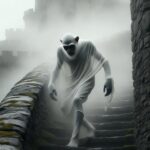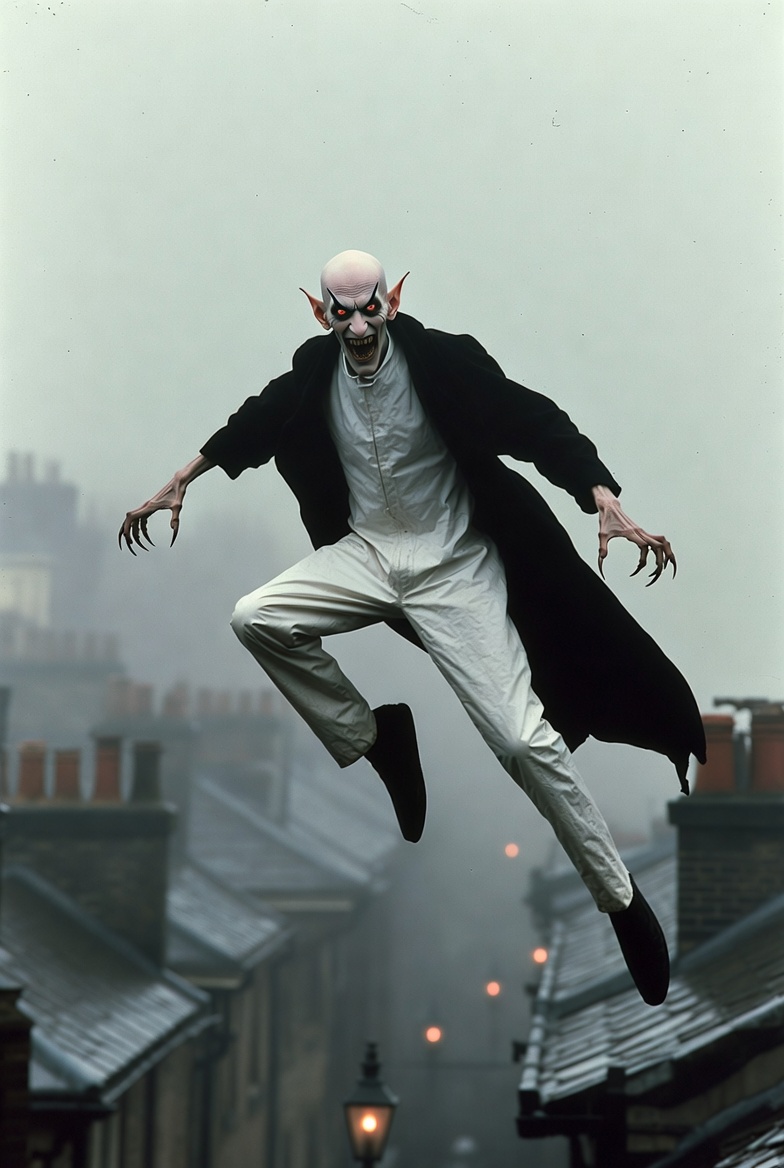
Spring-heeled Jack is one of the most famous figures in English folklore and Victorian urban legend—a mysterious, devil-like entity that supposedly terrorized parts of the United Kingdom, especially suburban London, during the 19th century. The legend began in the late 1830s, with the first reported sightings around 1837 in London. A businessman claimed to see a strange figure leaping effortlessly over high railings or cemetery walls, landing in his path with startling agility. The name “Spring-heeled Jack” came from witnesses’ descriptions of his incredible jumping ability—he could bound over tall fences, rooftops, walls (sometimes up to 9 feet or more in a single leap), and escape pursuers with superhuman speed and grace, as if he had springs in his heels. Eyewitness accounts painted a consistently terrifying picture of his appearance: Tall and thin, often described as muscular or athletic despite the lankiness.
Diabolical or monstrous features: pointed ears, a pointed nose, sometimes horns or a goatee beard, and a hideous, devilish face.
Eyes that glowed like “red balls of fire,” “flaming red wheels,” or burning coals—often the most striking and frightening detail.
Clawed hands, usually metallic or iron-like, sharp enough to tear clothing or scratch victims.
Attire that varied but commonly included a tight-fitting white or oilskin garment (like a bodysuit), a helmet (sometimes brass or horned), a flowing black cloak or cape, and occasionally Armor-like elements.
Some reports added even more supernatural flair: he could breathe or vomit blue-white flames from his mouth (often when startling victims with a candle or light), emit fiendish laughter, or appear accompanied by other ghostly figures. His behaviour was more prankish and harassing than outright murderous—he targeted women and young people most often, jumping out to scare them, ripping at clothes with claws, or causing chaos by leaping in front of carriages to spook horses. Famous early incidents include attacks on Jane Alsop (who handed him a candle only for him to reveal his fiery, clawed form) and others in Limehouse or Old Ford areas in 1838. Sightings spread across England (including the Midlands, Black Country, and Scotland), peaking in waves through the 1840s–1880s, with the last widely reported newspaper accounts around 1904 in Liverpool or the Black Country. Theories about what (or who) he really was range widely: a demonic entity or phantom, an extra-terrestrials being, a hoax/prankster (perhaps a nobleman like the Marquess of Waterford, known for wild bets and mischief, using gadgets or stilts), mass hysteria amplified by sensational penny dreadful magazines and newspapers, or misidentifications of ordinary people in costumes during a time of gothic fascination. No concrete evidence ever proved his existence, and mainstream views treat it as folklore born from Victorian fears, urban anxiety, and media sensationalism. The legend has endured, inspiring fiction, comics (influencing characters like Batman), books, and modern retellings, though genuine new sightings are rare to non-existent in recent decades—no major reports have emerged in the 2020s or early 2026. It’s remembered as a quintessential Victorian boogeymen: part ghost, part supervillain, all nightmare fuel. If you’re curious about specific incidents or comparisons to other cryptids, let me know!
About the Author