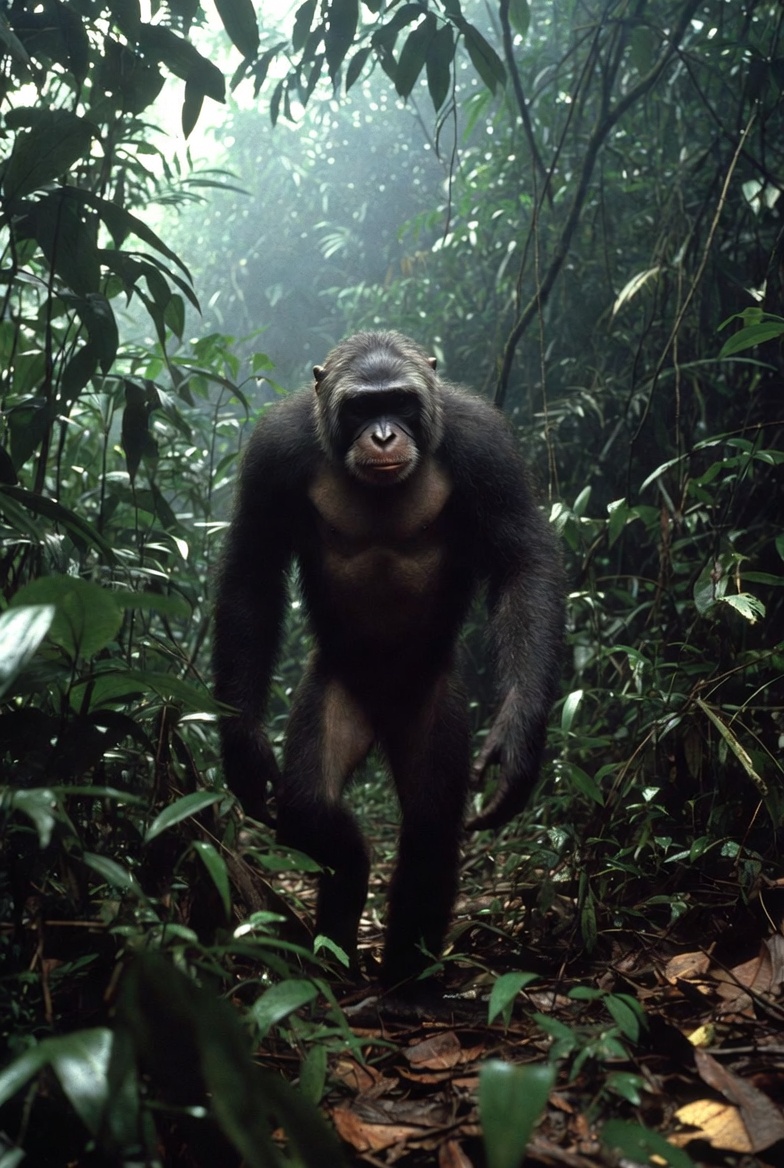
The orang pendek (Indonesian for “short person”) is a legendary cryptid said to inhabit the remote, mountainous rainforests of Sumatra, Indonesia. It’s one of the more consistently described unknown primates in cryptozoology, with reports spanning over a century from local indigenous groups (like the Orang Rimba, who sometimes call it “hantu pendek” or “short ghost”), villagers, Dutch colonial-era witnesses, and modern researchers or expedition members. Typical descriptions from eyewitness accounts include: Height: Usually 80–150 cm (roughly 2.5–5 feet), most often around 3–4 feet tall—much shorter than a human but stockier than typical apes.
Build: Muscular and powerfully built, with broad shoulders, a thick chest, long strong arms (sometimes reaching near the knees when standing), and thick, sturdy fingers or hands. It walks bipedally (upright on two legs) in a confident, human-like manner, though it may use its arms for support or climbing.
Appearance: Covered in short, dense fur that’s typically dark—black, dark grey, or black flecked with grey—but some reports mention reddish-brown, honey-coloured, or tan shades. The face is often described as ape-like or humanoid, with a broad mouth, no pronounced snout (unlike monkeys), and sometimes lighter fur on the front of the body.
Behaviour: Shy and elusive, tending to flee from humans quickly. It’s terrestrial and ground-dwelling rather than highly arboreal, said to be omnivorous—raiding crops like durian, sugarcane, potatoes, or other plants near forest edges, and occasionally breaking into huts for food. Some accounts note it can uproot small trees or snap tough vines with its strength, and it may emit short vocalizations.
The creature is most frequently associated with Kerinci Seblat National Park (one of Sumatra’s largest protected areas), the Bukit Barisan mountain range, areas around Gunung Kerinci volcano, Lake Gunung Tujuh (Lake of Seven Peaks), and other rugged, densely forested highlands in central and western Sumatra. Sightings have been reported for generations, with some consistency in details across locals and occasional Western visitors or scientists. Expeditions (including those by cryptozoologists and funded projects) have occasionally claimed footprint casts, hair samples, or brief glimpses, but no conclusive proof—like clear photos, a body, or verified DNA—has emerged. Mainstream science generally regards it as unproven, often attributing reports to misidentifications of known animals (such as sun bears standing upright, large gibbons, siamang apes, or even feral humans in poor visibility), cultural folklore amplification, or optical illusions in thick jungle. However, its plausibility is debated more favourably than some cryptids due to the habitat’s remoteness, the discovery of other hidden primates in Indonesia (like the Tapanuli orangutan in recent years), and parallels to real extinct hominins (e.g., Homo floresiensis, the small “hobbit” species from nearby Flores).
No major new confirmed sightings or breakthroughs appear to have surfaced in early 2026, though anecdotal reports and discussions in cryptozoology circles continue, often tied to the area’s ongoing “high strangeness” reputation. If you’re interested in a specific aspect (like expedition stories or comparisons to other cryptids), let me know!
About the Author