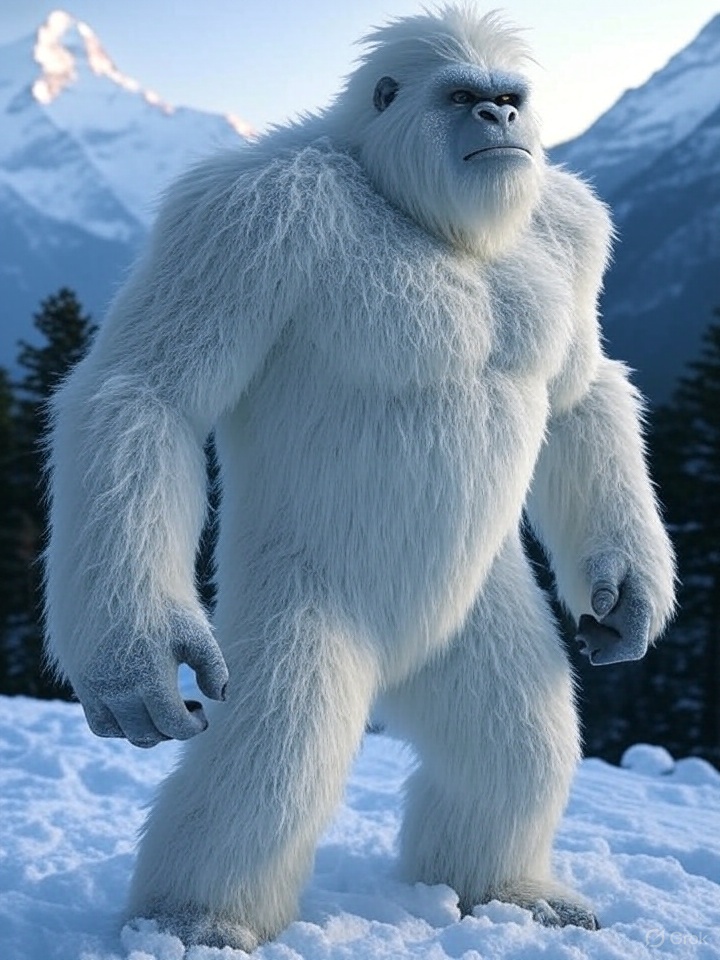
The yeti, often called the “Abominable Snowman,” is a legendary creature rooted in Himalayan folklore, particularly among the Sherpa people of Nepal, Tibet, and Bhutan. Described as a large, ape-like being covered in white or gray fur, the yeti is said to inhabit the remote, snow-covered peaks of the Himalayas, like Mount Everest. Its story blends myth, cultural tradition, and modern fascination with cryptids—creatures whose existence remains unproven.
Origins in Himalayan Folklore
The yeti’s legend likely began centuries ago among indigenous Himalayan communities. The word “yeti” comes from the Sherpa term yeh-teh, meaning “small, man-like animal” or “rock bear.” In Sherpa and Tibetan tales, the yeti is a mysterious, elusive figure, sometimes a protector of the mountains, sometimes a dangerous spirit. Stories describe it as a nocturnal creature, leaving massive footprints in the snow and occasionally raiding villages for food or livestock. Some Buddhist monasteries claim to house yeti relics, like scalps or bones, revered as sacred artifacts. For example, the Pangboche Monastery in Nepal once displayed a supposed yeti scalp, later analyzed and found to be from a serow (a goat-like animal).
These tales served cultural purposes, reinforcing respect for the harsh mountain environment and explaining unexplained phenomena, like strange tracks or sounds in the wilderness. The yeti also appears in pre-Buddhist Bon religion, tied to mountain deities and nature spirits.
Western Discovery and Popularization
The yeti entered Western consciousness in the 19th and 20th centuries as explorers and mountaineers ventured into the Himalayas. In 1832, British official James Prinsep reported a sighting by his porters of a hairy, bipedal creature in Nepal. The term “Abominable Snowman” emerged in 1921 when journalist Henry Newman mistranslated metoh kangmi (“filthy snowman”) from a Sherpa account of a sighting.
The 20th century fueled yeti mania. In 1951, British mountaineer Eric Shipton photographed large, humanoid footprints during an Everest expedition, sparking global intrigue. These tracks, found at 20,000 feet, were too large for known animals like bears or snow leopards. Subsequent expeditions, like the 1954 Daily Mail Snowman Expedition, sought the yeti but found only ambiguous evidence—Í0. In 1953, Edmund Hillary and Tenzing Norgay reported yeti tracks during their historic Everest climb, further cementing the creature’s fame.
Western media sensationalized the yeti, blending serious speculation with pop culture exaggeration. Books, films, and TV shows—like the 1957 film The Abominable Snowman—portrayed it as a monstrous beast, diverging from the more nuanced Sherpa stories.
Evidence and Scientific Scrutiny
No definitive proof of the yeti exists. Footprints, hair samples, and alleged sightings dominate the evidence, but scientific analysis often disappoints. For instance, a 2014 DNA study of supposed yeti hair from various global cryptid sightings (yeti, Bigfoot, etc.) found most samples matched known animals like bears, dogs, or cows. A 2017 study by Oxford University Press analyzed nine “yeti” samples from the Himalayas, concluding all were from Himalayan or Tibetan brown bears or black bears. Footprints, like Shipton’s, are often explained as distorted bear tracks, melted by sun or wind to appear larger and humanoid.
Skeptics argue the yeti is a misidentification of bears or other wildlife, compounded by high-altitude hallucinations or cultural storytelling. Believers, however, point to consistent eyewitness accounts and the vast, unexplored Himalayan wilderness as reason to keep searching. Cryptozoologists speculate the yeti could be a surviving prehistoric ape, like a Gigantopithecus, though no fossils of such a creature have been found in the Himalayas.
Modern Cultural Impact
The yeti remains a global icon, appearing in everything from Disney’s Monsters, Inc. (as the lovable “Yeti”) to Indian Army claims in 2019 of discovering yeti footprints in the Himalayas, which reignited debate but were widely dismissed as bear tracks. On X, posts about the yeti range from humorous memes to serious cryptozoology discussions, reflecting its dual role as both a cultural joke and a persistent mystery. For example, a 2023 X post by
@HimalayanTales shared Sherpa stories of yeti sightings, emphasizing their spiritual significance, while others, like
@CryptoQuestX, speculated on yeti-Bigfoot connections.
Conclusion
The yeti’s story is a tapestry of ancient Himalayan lore, colonial-era fascination, and modern cryptozoological debate. While science leans toward natural explanations—bears, optical illusions, or folklore—the lack of definitive disproof keeps the legend alive. The yeti endures as a symbol of the unknown, embodying humanity’s curiosity about the wild, uncharted corners of the world. Whether real or not, its footprints in culture are indelible.
About the Author