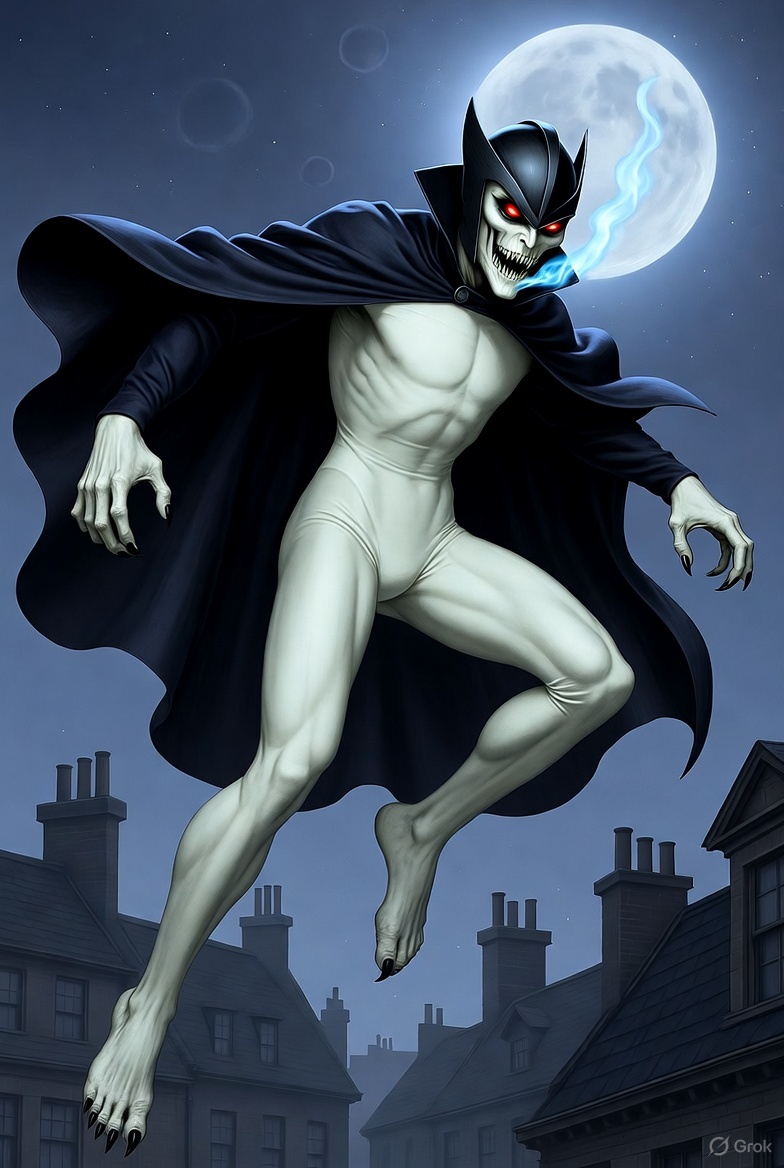
Spring-heeled Jack: The Victorian-Era PhantomSpring-heeled Jack is one of England’s most enduring urban legends, a mysterious figure from Victorian folklore who terrorized the streets of 19th-century Britain. Emerging in the late 1830s, he was depicted as a diabolical, acrobatic creature capable of extraordinary leaps—hence the “spring-heeled” moniker—often attributed to mechanical springs hidden in his boots. Sightings peaked in suburban London, the Midlands, and Scotland, blending elements of ghost stories, prankster mischief, and outright supernatural horror.Origins and Early SightingsThe legend began in September 1837, when a businessman in London’s Barnes Cemetery claimed to see a tall, shadowy figure effortlessly vault over high railings in a single bound. This kicked off a wave of reports, with Jack described as a pale-skinned humanoid standing over 7 feet tall, clad in a tight white garment under a black cloak, wearing a helmet, and sporting clawed hands. His most chilling feature? Eyes like glowing red fireballs and the ability to breathe blue flames from his mouth, which he allegedly used to blind victims.By 1838, panic spread. Jack was blamed for stalking lone pedestrians, particularly women, at night. He was said to prey on the vulnerable, slashing at clothing with his claws and emitting eerie shrieks before bounding away over walls or rooftops. The press sensationalized the story, dubbing him “the suburban ghost” or “Steel Jack,” and he became a bogeyman used to scare misbehaving children.Notable AttacksTwo incidents in early 1838 cemented Jack’s notoriety and led to public outrage:
- Jane Alsop Attack (January 1838): A 15-year-old girl in Bearbinder Lane, Stratford, answered her door to a man claiming to be a policeman who had captured “Spring-heeled Jack.” He demanded a candle, then revealed his face—ghastly white with blazing eyes—and vomited blue flames at her. He tore at her dress with metallic claws before her screams drove him off. This story exploded in newspapers like The Times.
- Lucy Scales Attack (February 1838): In Green Dragon Alley, Limehouse, 18-year-old Lucy was walking with her sister when Jack appeared, exhaled flames that temporarily blinded her, and clawed her neck. He fled after witnesses approached. Unlike Alsop’s case, this received less coverage but fueled rumors of a serial predator.
These events prompted the Lord Mayor of London to convene a special session, warning citizens and even forming vigilante patrols. Sightings continued sporadically: In April 1838, a gardener in Rosehill, Sussex, reported a similar leaping fiend. By the 1840s, Jack had migrated north to the Black Country and Liverpool, where crowds allegedly chased him across rooftops. One 1904 account from Everton described him perching on a church steeple before vanishing.Theories and ExplanationsWhat was Spring-heeled Jack? Theories abound, reflecting the era’s mix of rational skepticism and gothic fascination:
- Prankster Aristocrats: The most popular mundane explanation points to bored noblemen, possibly led by the Marquess of Waterford (a notorious prankster exiled from England in 1839). Rumors swirled of a £5,000 wager among “ghost clubs” to terrorize Londoners using costumes, phosphorus for “flames,” and spring-loaded stilts for jumps. This aligns with earlier ghost scares like the Hammersmith Ghost of 1803–04, which turned out to be a local man in a sheet.
- Supernatural Entity: Many Victorians saw him as a demon or devilish imp, tying into broader folklore of fire-breathing specters. Some even linked him to earlier apparitions, like the 10-foot-tall Southampton ghost that leaped over houses.
- Wilder Ideas: Fringe theories include an escaped circus kangaroo (unlikely), an alien visitor, or a manifestation of urban anxiety amid rapid industrialization and crime waves (e.g., overlapping with Jack the Ripper fears in 1888, when a hoax letter signed “Spring-heeled Jack—the Whitechapel Murderer” surfaced).
No one was ever conclusively caught, and sightings faded after the 1900s. A final flurry came in the 1950s in Galmington, Somerset, but these are widely dismissed as copycats.Cultural LegacySpring-heeled Jack evolved from villain to anti-hero in pop culture. He inspired penny dreadfuls, comics (like the 1970s Pow! and Wow! series where he fights crime), and modern media, including Alan Moore’s From Hell (nodding to Ripper connections). Today, he’s a symbol of Victorian weirdness, with echoes in cryptozoology and even a ska band named after him. A coffee roastery in the U.S. also borrows the name, proving his leap across centuries endures. If you’re diving into this for a specific angle—like theories, comics, or modern sightings—let me know for more details!
About the Author